By Chester McConnell, FOTWW
Whooping Crane “stopover habitat” project Management Team travels North
Efforts to identify, improve and protect Whooping Crane “stopover habitats” on military bases is a vital component in attempts to assist the only remaining wild Whooping Crane population on the planet. The Whooping Crane “stopover habitat” project Management Team traveled into Oklahoma and Kansas recently to continue evaluation of suitable sites on military lands. Stopover habitats are essential components of the ecosystems needs of Whooping Cranes.
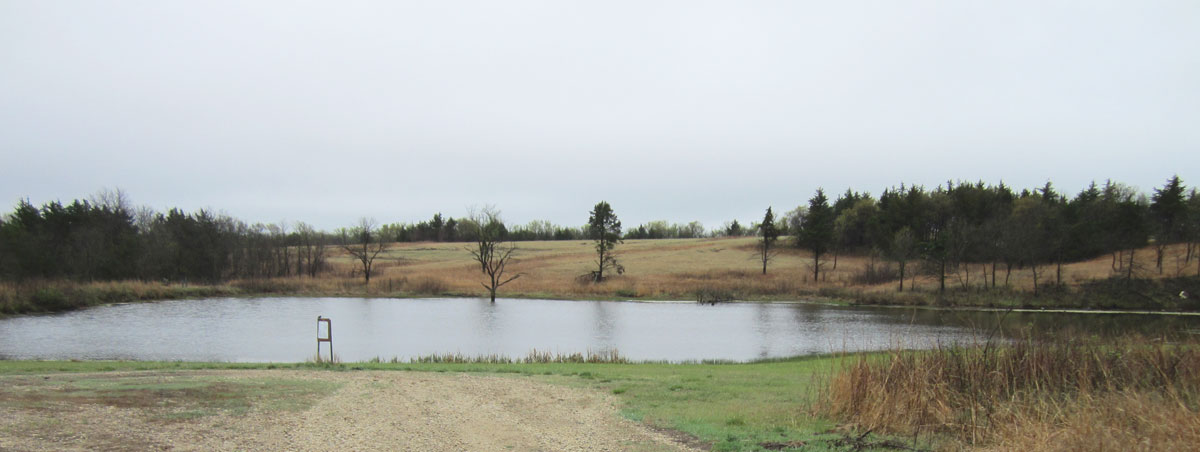
— Beck Pond on Fort Riley, Kansas provides all the components for an excellent Whooping Crane “stopover habitat. Much of the shore is clear of tall vegetation and provides open space for a landing site. Pond banks have gradual slopes into the water and shallow areas for roosting sites. Much of the surrounding area is open which allows Whooping Cranes to observe predators. —
Whooping Crane habitat types
Basically there are three habitat types used by Whooping Cranes.
(1) Nesting habitat on Wood Buffalo National Park, Canada is vital for reproduction and adding more cranes to the population.
(2) Wintering habitat at Aransas National Wildlife Refuge on the Texas coast is likewise important to allow a warm place with abundant high quality food to allow cranes to rest and recuperate from the nesting season and long migration flights.
(3) Stopover habitats are essential all along the 2,500 mile migration corridor so Whooping Cranes can rest and feed during their long flights between Wood Buffalo and Aransas.
Whoopers must stopover 10 to 20 times to rest and feed during each of their two annual migration. Each of the three habitats types is essential to the survival of endangered Whoopers.
Wetland ponds evaluated
Sixteen wetland ponds were evaluated on three military installations by the Management Team from Friends of the Wild Whoopers (FOTWW) and Gulf Coast Bird Observatory (GCBO). Management recommendations were made that would improve and maintain these wetland ponds as prime stopover habitats. Importantly, many other wetland habitats are located on each base that could be relatively easily and inexpensively developed as stopover habitats if the need arises. Wildlife personnel on each base visited could bring additional ponds up to standard using the information provided to them by the Management Team.
We invite you to be a partner with us in this important stopover habitat project
We need your help. FOTWW’s travel expense (motels, auto expense, and meals) cost an average of $270 per day. If you would like to help, you can send us a donation by check, credit card, or PayPal. Please click here and then click on “become a Friend (member) of the Wild Whoopers”.
Please help us, help them!
THANK YOU!
FOTWW
friendsofthewildwhoopers.org
***** FOTWW’s mission is to help preserve and protect the Aransas/Wood Buffalo
population of wild whooping cranes and their habitat. *****
Friends of the Wild Whoopers is a nonprofit 501(c)3 organization.