by Chester McConnell, Friends of the Wild Whoopers
To some, the southward migration of Whooping Cranes seems to be a bit later than usual this year. Four whoopers were early birds and reached Aransas National Wildlife Refuge in mid-September. Now that was early! But in spite of human interests, nature has a way of setting its own schedule. Then, yesterday (10-23-2014), Aransas Bay Birding Charters boat captain, Captain Kevin Sims spotted 8 Whoopers on Aransas Refuge. So, it appears the Whoopers are now arriving on Aransas Refuge as nature plans.
Normally autumn migration begins in mid-September, with most Whoopers arriving on the Aransas wintering grounds between late October and mid-November. So, actually it appears that the whoopers may just be on schedule. Occasionally, a few stragglers may not even arrive on Aransas until late December.
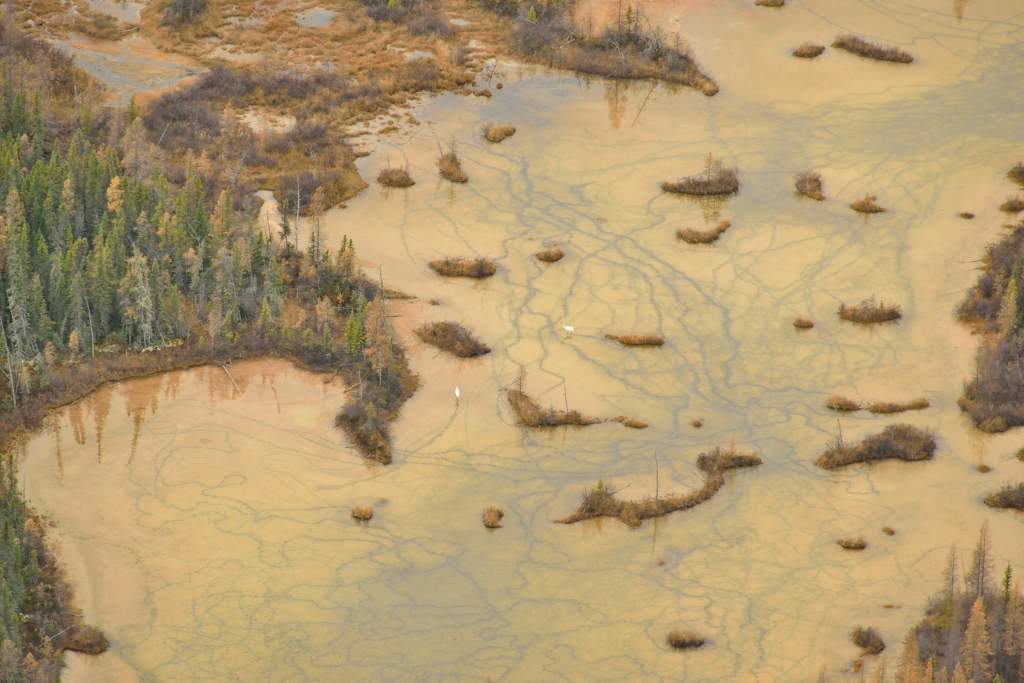
Some Whooping Cranes still on Wood Buffalo National Park nesting ground on Oct. 8, 2014. Note the two Whooping Cranes in the pond. Photo credit: ©Parks Canada /Wood Buffalo National Park/ John McKinnon — Click on photo to enlarge.
Friends of the Wild Whoopers (FOTWW) talked today with John McKinnon about the migration. John is the Environmental Technician for Wood Buffalo National Park (WBNP), nesting area of Whooping Cranes. He told FOTWW about a helicopter flight he made over parts of the WBNP nesting grounds during October 8 – 9. The flight involved another project but he also kept on the lookout for Whooping Cranes. John advised that he observed 24 whooping cranes (21 adults and 3 juveniles) on the area that he flew over.
McKinnon also related to FOTWW that food was still plentiful on Wood Buffalo which tends to hold the Whoopers on the park. He also explained that the ponds on Wood Buffalo are now freezing over and he believes this will cause the remaining Whoopers to soon head southward on their 2,500 mile migration.
Whooping Crane pairs with young are commonly among the last to leave the WBNP breeding territory. Whoopers migrate south as singles, pairs, in family groups, or as small flocks of 3 to 5 birds. They migrate during day time and make regular stops during their 2,500 mile migration to feed and rest. Larger groups of up to 20 sometimes use the same stopover location, primarily on harvested agricultural fields.
Whoopers departing WBNP often make their first stops in northeast Alberta or northwest Saskatchewan, about 300 miles southeast of their departure area in WBNP. They usually reach the autumn staging grounds in the north-central portion of the Saskatchewan agricultural area on the second day of migration although weather conditions affect distance and direction of travel.
The first stop over for most of the cranes last for 2 to 4 weeks in the large triangle between Regina, Swift Current, and Meadow Lake. While there they feed on waste grain in wheat and barley stubble fields and roost in the many wetlands available. The remainder of the southward migration from Saskatchewan to the Texas coast wintering grounds is usually fairly rapid, depending on weather conditions. If the Whoopers catch good weather conditions they can complete their migration from south Canada in a week.
With the facts in mind, we must be patient for the Whoopers to reach Aransas National Wildlife Refuge. And, importantly, if we want wild Whooping Cranes to thrive and continue their migrations we must do more to save their habitats. To help we urge you to become a “Whooper Friend” or to donate click on: Become a “Friend” of the Wild Whoopers.
***** FOTWW’s mission is to help preserve and protect the Aransas/Wood Buffalo
population of wild whooping cranes and their habitat. *****

friendsofthewildwhoopers.org


