Wintering Whooping Crane Update
Wade Harrell, U.S. Whooping Crane Recovery Coordinator

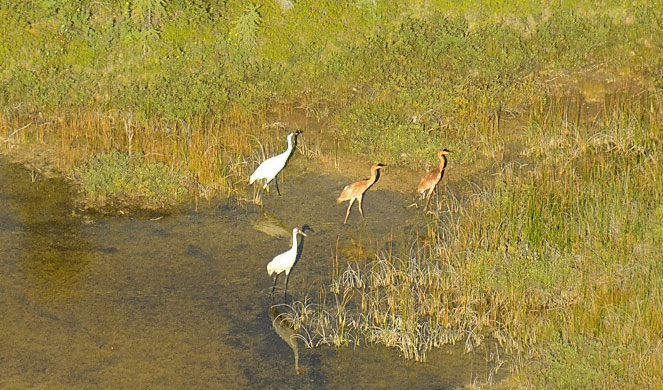
Whooping crane family at Aransas National WIldlife Refuge. Photo courtesy of Kevin Sims.
We completed our annual whooping crane abundance survey this week, flying nearly six surveys. Unfortunately, we were plagued with poor flying conditions throughout the survey period. Of the nine days we had pilots and planes available, only five days (Dec. 9, 10, 11, 13, 14) offered safe enough conditions to fly. Of those five days, only two days (Dec. 9 and 13) had good flying weather most of the day, allowing for complete surveys. Fog, rain, low ceilings and high winds all contributed to poor flying conditions. Fortunately, we had two pilots and planes from our Migratory Birds program and four observers available, allowing us to fly more than one survey a day.

Aransas NWR biologist Diana Iriarte and Migratory Birds Program pilot biologist Terry Liddick preparing for the first whooping crane survey of the season
Once again, Terry Liddick, pilot/biologist from our Migratory Birds program, served as a pilot, flying a U.S. Fish and Wildlife Service Cessna 206. This year Phil Thorpe also served as a pilot, flying a U.S. Fish and Wildlife Service wheeled Kodiak. Observers were Wade Harrell, Jena Moon (Refuges Inventory and Monitoring biologist), Doug Head(Refuges Inventory and Monitoring biologist) and Stephen LeJeune (Chenier Plains Refuge Complex Fire Program). Doug Head (Refuge Inventory and Management biologist) served as survey coordinator.
Whooping Crane abundance survey results to be released in a few months
Data management and analysis once the actual survey is complete is a significant effort conducted by multiple staff members, so we won’t have the final results to present for a few months. But, I will share some general post-survey observations:
We observed whooping cranes using four units of Aransas National Wildlife Refuge (Blackjack, Matagorda, Tatton and Lamar) and 3 Texas coastal counties (Aransas, Calhoun and Matagorda).
- Overall, habitat appeared to be in good condition with adequate freshwater resources. Northern portions of the primary survey area (Welder Flats, Matagorda Island Central) appeared to have much more standing freshwater than southern portions of the primary survey area (Blackjack, Lamar-Tatton), presumably due to higher rainfall totals over the last couple months. Coastal marshes had higher than normal water levels due to high tides in the early part of the survey; however tides fell to normal levels this week.
- We observed significant amounts of water hyacinth, an invasive freshwater plant, floating in San Antonio Bay, presumably having been flushed out of the Guadalupe River after the last flood event in November. Rainfall in November and December has provided positive freshwater inflows into local estuaries.
- This year we did not have as many large group sizes (>8) of whooping cranes in our primary survey blocks, so it is possible that many of the subadult groups we observed in the past few years have successfully paired.We observed at least one family group that included two juveniles (i.e. commonly referred to as “twins”).
- Due to poor flying conditions, most of our secondary areas did not get surveyed, but we did have one survey over the Mad Island and Matagorda Peninsula secondary areas. The Mad Island secondary survey area had one family group and two additional adult whooping cranes detected.
- A family group of whooping cranes was reported in a rice field near Garwood, TX on December 8th. This area has had whooping crane use the last several years and is well outside (north) of our survey area.
- While coastal salt marsh was the most common habitat type that we observed whooping cranes using during the survey, we observed whooping cranes using a wide variety of other habitat types as well, including freshwater wetlands, upland prairies and shrublands, agricultural fields and open-water bay edges.
There are several opportunities for visitors to Aransas National Wildlife Refuge to view whooping cranes in publically accessible areas this winter. Whooping cranes have been consistently sighted from the Heron Flats viewing deck, the observation tower and the tour loop near Mustang Slough. We consistently observed a family group of whooping crane in the Mustang Lake salt marsh in front of the observation tower, so you have an excellent opportunity to view whooping crane behavior with a juvenile in tow in their natural habitat.
Whooping Crane abundance survey a collective effort
I want to note that the annual whooping crane abundance survey is a collective effort, with the pilot and observers in the plane only serving one small role within the overall survey. I want to personally thank Joe Saenz, Aransas NWR project leader, for serving as overall manager of the effort; Doug Head, Refuge Inventory & Monitoring biologist as survey coordinator; Josie Farias, administrative staff at Aransas NWR, for assisting with logistics and dispatch; and Grant Harris and Matthew Butler from our Refuge Regional Office Inventory & Monitoring Team for survey protocol development and data analysis.
We will be flying some additional surveys in February in order to complete our survey of secondary areas and train new observers.
Habitat Management on Aransas NWR:
No prescribed burns have taken place yet this winter; however, we are planning for prescribed burns on the Blackjack
Unit, Tatton Unit and Matagorda Unit of Aransas NWR this winter.
Current refuge conditions
Recent Precipitation/Salinity around Aransas NWR:
November precipitation: 2.57” @ Aransas HQ
December precipitation (as of 12/15): 2.62” @ Aransas HQ
Salinity at GBRA 1: averaging around 13 parts per thousand
***** FOTWW’s mission is to help preserve and protect the Aransas/Wood Buffalo
population of wild whooping cranes and their habitat. *****
Friends of the Wild Whoopers is a nonprofit 501(c)3 organization.
friendsofthewildwhoopers.org