Wintering Whooping Crane Update, March 29, 2016

Wintering Whooping Crane Update, March 29, 2016

Wade Harrell, U.S. Whooping Crane Recovery Coordinator

Whooping crane spring migration has begun. It has been a tremendous winter season here at Aransas NWR, but the whooping cranes seem to be ready to get back up to Wood Buffalo National Park for another breeding season.

As of this morning, of 11 birds that have active satellite transmitters, 4 have departed Aransas NWR. The 4 marked cranes are spread out from Central Texas to South Dakota. Reports received over the last few weeks from states in the migration corridor indicate 31 whooping cranes have been spotted in migration from Kansas to South Dakota. The number of whooping cranes at Aransas will quickly dwindle over the next few weeks. Spring migration is typically shorter in duration than fall migration, usually taking about 30 days.

We have posted the 2014-2015 Whooping Crane Recovery Report on our website. As soon as results from the Annual Whooping Crane Winter Abundance Survey are complete, we will post a summary on the Aransas NWR website as well.

Whooping Cranes on the Refuge

Cranes were recently seen from the observation tower on the Refuge, but it’s difficult to say how much longer they will remain. There are many other interesting wildlife species to view at the Refuge now, though, so don’t hesitate to come out and enjoy other spring wildlife watching opportunities! Our Rail Trail bridge has recently been rebuilt, and it’s been a great spot to see young alligators, bullfrogs, and colorful fish.

Texas Whooper Watch

Please report any whooping cranes you observe migrating in Texas to Texas Whooper Watch. The old saying “a photo is worth a thousand words” applies to reporting whooping cranes as well. Just be careful not to disturb or get too close the birds!

While we didn’t have nearly as many whooping cranes use inland sites this winter, Texas Whooper Watch still provided us vital information during migration. Please continue to keep watch for whooping cranes and send in your reports.

Habitat management on the Refuge

Refuge staff burned 8 units this winter, totaling 5,822 acres. This year’s season was difficult in terms of meeting objectives due to smoke management and weather windows. The season started off very wet from the effects of the above average rainfall in calendar year 2015 and the anticipation of a predicted wet winter from El Nino conditions. The wet conditions persisted into early January and then rapidly changed. The predicted El Nino event never materialized for January/February and many dry fronts came through South Texas resulting in conditions outside of prescription with relative humidities in the teens.

Units burned in January and February continue to exhibit excellent wildlife response. Crane units 6 and 7, along with the burns on the south end of Matagorda Island, showed prolonged whooping crane use with over 40 individuals counted on single burn units at times.

Precipitation/Salinity:

The Refuge received 5.53 inches of rain from January-March 28. Freshwater levels and food resources remained high throughout this winter season. Salinity levels in San Antonio Bay are currently around 10-12 parts per thousand.
friendsofthewildwhoopers.org logo

friendsofthewildwhoopers.org

***** FOTWW’s mission is to help preserve and protect the Aransas/Wood Buffalo
population of wild whooping cranes and their habitat. *****
Friends of the Wild Whoopers is a nonprofit 501(c)3 organization.

FacebookTwitterGoogle+Share

Whooping Crane Nesting Grounds in Winter

The only wild Whooping Crane population on earth is currently in the process of migrating northward from Aransas Wildlife Refuge, Texas to Wood Buffalo National Park, Northwest Territories, Canada. Wood Buffalo is their only nesting area. While we wait for the USFWS Southwest Region statisticians to analyze and release their final estimate of the December aerial survey, Friends Of The Wild Whoopers (FOTWW) thought we would provide you with something a little different.

Every year, in July, Parks Canada and Canadian Wildlife Service conducts two aerial surveys over the Whooping Crane nesting grounds. They provide FOTWW with the results of the nests count in June and later in August, the fledgling count. Normally we get a bonus of some photos of the beautiful nesting grounds.

Winter Conditions

What many don’t know is that Parks Canada also does an Aerial Bison Survey within Wood Buffalo National Park. John McKinnon, Parks Canada participated in this year’s survey, on Tuesday, March 15, 2016. During the Bison Survey, the flight crossed over Whooping Crane nesting grounds. McKinnon made some photos and sent FOTWW a couple of the nesting grounds along with an update on the conditions at the park.

McKinnon reports, “We were out conducting our Aerial Bison Survey at the Park last week and I took a few photos of the Sass Nesting Area and the Klewi Nesting Area on Tuesday, March 15, 2016.”

According to McKinnon, “Things should be changing fairly quickly up here (i.e. melting)… as the weather forecast is for positive temperatures in the upcoming week ahead. We have been having a stretch of cold nights, -20°C, (-4°F), -ish, and daytime temps of -5°C, to -8°C, (28°F to 17°F).”

McKinnon explained, ”We have lots of snow this year, which should bode well for the Whooper’s Habitat. The snow pack is more than we have had the last couple of years; kind of back to being like “normal”.”

Looking forward

After the drought on the nesting area last summer, John’s report sounds promising and we hope that once the snow pack melts, that conditions will be ideal and that the number of nests and fledglings will be higher than it was during last year’s drought.

Some of the nesting areas may still be frozen when the wild Whoopers arrive on Wood Buffalo. Yet the wild cranes have faced these conditions in previous years and have learned to live with them.

John sent us a couple of photos that he took while flying over the Whooping Crane nesting grounds. Hope you find them interesting.

Whooping Crane Nesting Grounds

Klewi nesting area at Wood Buffalo National Park. Photo ©John McKinnon

Whooping Crane Nesting Grounds

Sass nesting area at Wood Buffalo National Park. Photo ©John McKinnon


The landscape on the nesting grounds is beautiful and serene in the winter, but as we move forward into spring and summer, the landscape is born again, nests will be built, and chicks hatched. Knowing what lies ahead for the wild Whooping Crane population and WBNP, we can be assured that we will once again see images such as those below.

This photo shows the same nesting area in spring-summer as the snow and ice covered photos above.

Whooping crane nesting grounds.

Photo: Whooping Crane Nesting Grounds in Wood Buffalo National Park ©2014 John McKinnon , ©Parks Canada /Wood Buffalo National Park. Click on photo to enlarge.

This photo shows what we have to look forward to this spring-summer.

Whooping crane nesting grounds./Wood Buffalo National Park.

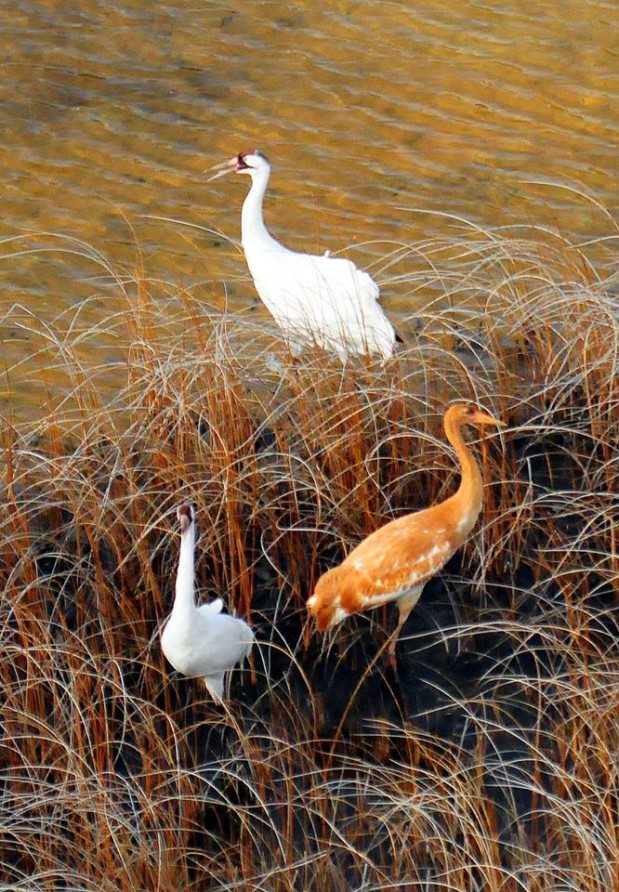
Two adults and one juvenile whooping crane. Photo: John McKinnon / ©Parks Canada /Wood Buffalo National Park.

FOTWW thanks John McKinnon for sending up the latest conditions on Wood Buffalo National Park and the beautiful photos of its landscape.

Whooping Crane

friendsofthewildwhoopers.org

***** FOTWW’s mission is to help preserve and protect the Aransas/Wood Buffalo
population of wild whooping cranes and their habitat. *****
Friends of the Wild Whoopers is a nonprofit 501(c)3 organization.